
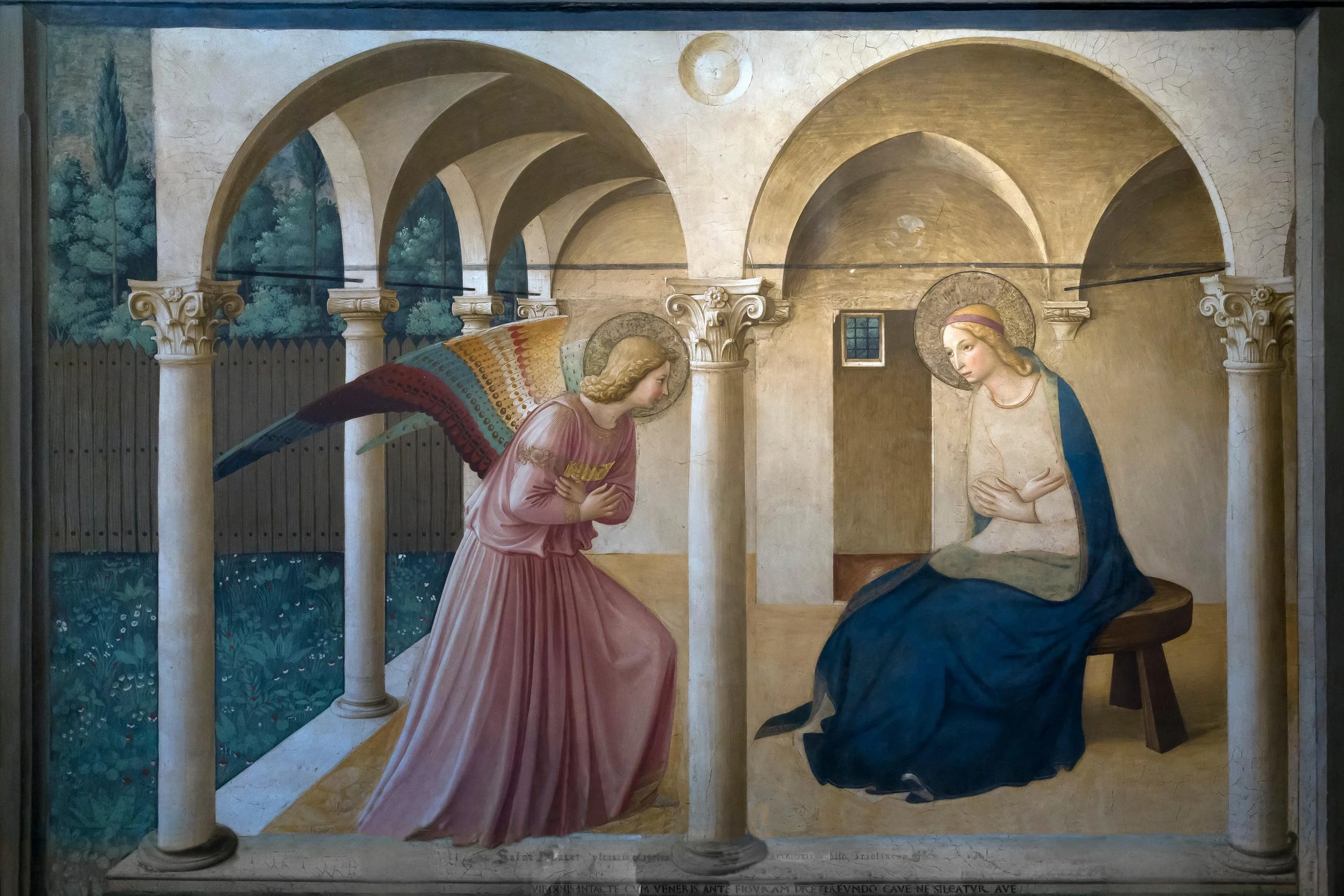
“The Annunciation” by Fra Angelico, dated 1440, and in Convent of San Marcos in Florence, Italy.
Christmas is a very special time for those of the Christian faith beyond the gifts, the trimmings, the parties, the festivities. For the Christian Christmas represents the birth of their Savior, Jesus Christ. He was born to save the world, to take upon Him all our sins.
An exquisite 15th-century Florentine work of art, “The Annunciation” by Fra Angelico, dated 1440, and in Convent of San Marcos in Florence, represents viscerally the moment the archangel Gabriel announces to Mary that she will bear the Son of God, The Son of Man, the one individual who will save mankind.
The scene is of the Archangel Gabriel visiting a young Virgin Mary to announce she would give birth to Jesus the Christ. This moment had been painted many times before, including by Fra Angelico, and this fresco is not the only artwork of the Annunciation found in the Convent of San Marco. The difference between Fra Angelico and his predecessors, however, is the environment shown. Whereas the angelic visitation previously had been depicted indoors, Fra Angelico is believed to have originated a novel composition of this famous scene and started a new trend, with Gabriel visiting Mary in an outdoor setting.
The scene takes place in a cloister, which is a covered walk, with arches and Composite columns featuring prominently. The Roman coposite columns display a style that combines elements seen in both ancient Greek and Corinthian columns. The middle column serves to separate the painting into two distinct spaces. The Roman arches give the composition a sense of balance, symmetry, and perspective.
The forms are graceful, the colors subdued. A light source warms the two figures in softness. Dressed in pink with multi-colored wings and a gold halo, the archangel Gabriel approaches the virgin Mary, gazing directly upon her. Gabriel’s arms are crossed over the heart area, as are Mary’s, symbolizing their acceptance of divine will and the magnitude of the message.
Young and sweet, Mary is astounded by Gabriel’s arrival. The viewer can see this in the expression on her face. She, too, has a gold halo, symbolizing holiness and her unique role as Jesus’ mother. A master of symbolism, Fra Angelico represented Mary’s innocence via the enclosed garden seen beyond the fence in the background. Her blue robes reflect her heavenly royal status as well as her humility.